Posts

Footwork in Meyer

Image
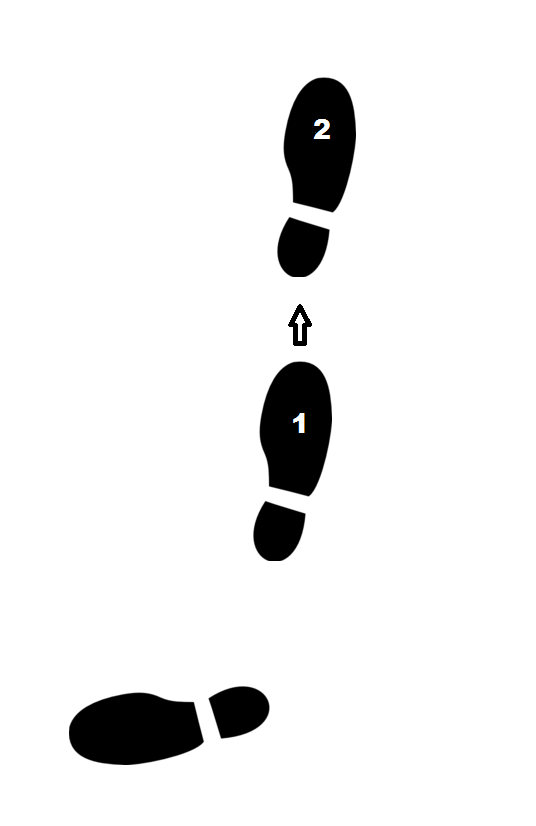
"All combat happens vainly, no matter how artful it is, if the steps for it are not executed correctly" - Joachim Meyer There are three steps in Meyer: The step   The basic "step" is outlined in detail in the Dussack cutting drills rather than the chapter on stepping in the Longsword.  Basically to go forward you move your lead foot forward a pace. Job done. This step might not seem like much of an action however if you start in Beginning stance and throw all of your body and weight behind it into a forward leaning position in End stance, you can generate a lot of power while only moving a short distance.    After that there seem to be several options:  1. you can recover this lead foot, like a mini-lunge 2. or take another step forward on the lead foot (particularly in the Rapier) to a proper lunge distance 3. or gather your rear foot to take another step forward "pull your rear foot up to the forward right one, so that you have anoth...

Some thoughts on using the Guards in Meyer

Image
"you must not remain in one guard, but always move from one to another and transform one into another, it will behoove you to pay good attention to how these guards follow from one another" - Joachim Meyer " now as regards the postures, I would not have you remain long in any of them, since they are not invented or devised for this purpose...linger in that furthermost point for just a bit, almost only for the blink of an eye" - Joachim Meyer Meyer is clear that the "guard" postures are not points that you hold but points that you transition through while making your cut or thrust. They represent moments in time where if your opponent reacts and your intended action doesn't look so good, you can change your intent. They also communicate your intent to your opponent who will have to react, in fairly set ways, to your projected intent. This conversation is the Art.  The human brain is hard wired to spot something that isn't moving sudde...

Using stance in Meyer

Image
"whichever leg stands in front is bent and the rear is extended to create a strong base" Andre Paurñfeyndt How to stand and how to move your body   Meyer has three ways to stand or stances; beginning, middle and end stance.  Meyer doesn't describe these positions, he leaves you to deduce this from his excellent woodcuts. Andre Paurñfeyndt, as above, does explicitly state how you should stand in his twelve teachings to the beginning fencer. Meyer, ever a fan of bells and whistles, obviously goes one further and also has a reversed or beginning version of this basic stance.  Beginning and end stances are the position of balance at the beginning and end of a cut. Starting in beginning stance, you cut through until you reach the end stance.  End stance End (see right) – characterised by the bent front leg and straight rear leg, as per Andre Paurñfeyndt. The Upper body starts at vertical and can lean forwards as it completes the cut until it is 45 d...

Fundamental Fitness

Image
light-footed - having a light and springy step flat-footed - unprepared and unable to react quickly My basic fitness re-training for my Western Martial Arts started in what some might consider being a slightly unusual place: re-training my feet. I was (still largely am) quite flat-footed and generally unbalanced so before I even consider touching a sword again I needed some fitness training to improve my ability to move my feet lightly, swiftly, with balance and power. All my future training would benefit. It’s long been remarked by Historical Fencers that people back in the day (prior to the 1970’s) didn’t wear padded shoes, so most clubs encourage people almost as a tradition to wear flat soled shoes. However from my experience, as someone who has generally worn flat soled shoes (converse, samba etc), this doesn’t really have the desired drastic improvement effect. So, after being introduced to Vibram five-fingers by Stuart Peers ( http://youtu.be/-ZqfvGxaboQ )...

What are the fundamentals?

“A Man may remember the whole parades of the sword, and yet not be able to act with such judgement as another, who perhaps has but an indifferent memory, yet knows the sum and substance of the art.” - Archibald MacGregor After many years of studying different manuscripts and practising different techniques I faced a conundrum: I could still be given a run for my money from someone who had only been in the club for a couple of weeks. My experience was that certain people could walk into the class, pick up a sword for the first time and within a week or two be beating everyone in the class, beginners and experienced alike. Why? Generally it was as simple as they had above average fitness.  This gave them the strength to move the sword with ease, they would have the stamina to hold their guards, the power to snap out the cuts and parries at speed. They would not be panting and dropping into low guards after 30 seconds. T hus they quickly picked up the basic technique...

Musing on the study of WMA

Life is short, this is God's way of encouraging a bit of focus.  ~Robert Brault Most people do not have the luxury of being able to study or train full time. It is an activity that we fit in around day jobs, study, family, children, second jobs and all the general hubbub of our lives. Therefore when we devote ourselves to poring over manuscripts in the wee small hours, snatched sessions of personal training, or training sessions: we need to be sure we’re getting the most from our time. The purpose of this article is to draw from my own experience and to offer some practical advice to help people get the most from their time. So to start off I would recommend you ask yourself the fundamental question: “what are your goals?” I think most people who want or who do study the martial arts draw from a variety of different motivations and I think with a bit of reflection you can make these explicit and then rank them in terms of importance. To give an example, for me, it bo...

Welcome

Welcome. This is a blog for my thoughts on the general study of Western Martial Arts and on the treatise of Joachim Meyer in particular. Deeds not words is my theme: a practical contribution to the common cause rather than criticism of the contributions of others.  I have much to learn and welcome proven learning from everyone of experience. If my ideas are different from your ideas, or if you are inspired by my ideas, I want to hear from you.